Other research articles
- Detergent Use Practices in Nepal: A Cross-Sectional Online Survey. Current Journal of Applied Science and Technology. 2020 Dec 4:111-8. Doi: 10.9734/cjast/2020/v39i3631079.
- Effect of Health Insurance Program in Social Security in Kailali District, Nepal. 2020; 4 (2): 1-5. Acta Scientific Pharmaceutical Sciences.
- Study of In-vitro Antioxidant and Antibacterial activity of leaf extract of Azadirachta indica, and Ocimum sanctum in different organic solvents and Cow urine. Journal of Drug Delivery and Therapeutics. 10.1-s (2020): 90-95. Doi: 10.22270/jddt.v10i1-s.3908.
- Anti-urolithiatic Property of Crataeva nurvala Root and Bark from Nepal on Ethylene Glycol induced Urolithiatic Mice. Journal of Pharmaceutical Sciences and Research. 2020 May 1;12(5):658-62.
- Personal Hygiene and Sanitary Practices among the School Girls in Dhangadhi, Nepal. advance.sagepub.com/articles/preprint. 2021.
- In-vitro Comparison of Anti-urolithiatic Effect of Crataeva nurvala, Zea mays (Corn Silk) and Ayurvedic Formulation Neeri Tablet. Int. J. Pharm. Sci. Rev. Res., 66(1), 2021; 07: 26-30.
Research output as part of PhD work
- Synthesis of Poly-Functionalized Indolizines via [5+1] Annulative Access to Pyridines (Adv. syn. Cat., 2021, 363, 23, 5330-5335).
- Regioselective Synthesis of 1-Cyano-3-arylindolizines: Construction of Pyrrole via DDQ-Mediated Ring Closure of Cyclopropyl Pyridines
- Domino [4 + 2] Annulation Access to Quinone–Indolizine Hybrids: Anticancer N-Fused Polycycles (J. Org. Chem. 2020, 85, 16, 10994-1005).
- Michael-Aldol-Double Elimination Cascade to Make Pyridines: Use of Chromone for the Synthesis of Indolizines (J. Org. Chem. 2021, 86, 15, 10235–10248). (Adv. Synth. Cat., 2022, July 25).
- One-pot access to 2-amino-3-arylbenzofurans: direct entry to polyheterocyclic chemical space (Org. Biomol. Chem., 2020,18, 8119-8140).
- Facile Access to 3, 4-Disubstituted 2H-Chromenes via Domino [4+ 2] Annulation (Synthesis 2021; 53(08): 1503-1512).
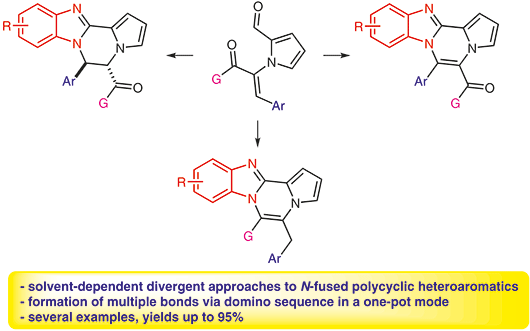
- Solvent-Controlled Divergent Syntheses of Polycyclic N-Fused Heteroaromatics (Synthesis. 2020, 52(19):2841-56).
- Benzofuro [2, 3-c] isoquinolines as novel AIEgens: Modulation of AIE characteristics by a single methoxy group. (Dyes and Pigments. 2022 Jul 21:110584).
- Generation of a Poly-Functionalized Indolizine Scaffold and Its Anticancer Activity in Pancreatic Cancer Cells. (Bioorganic Chemistry. 2022; 126: 105877).
- BF3.OEt2-Catalyzed One-pot Three-component Access to Diarymethylazides (Tetrahedron Letters. 2021, 67, 152820).
Solvent-Controlled Divergent Syntheses of Polycyclic N-Fused Heteroaromatics (Synthesis. 2020, 52(19):2841-56)
Authors: Anuradha Dagar, Dirgha Raj Joshi , Ikyon Kim∗
Abstract
Due to a growing interest in aza-fused polyaromatic systems among various sciences, enormous attention has been continuously paid to designing and synthesizing novel chemotypes of N-fused heterocycles. During the course of continued efforts in this line, it was found that divergent access to new polycyclic N-fused heteroaromatics was enabled by the choice of reaction solvent. Described herein are solvent-controlled selective approaches to three novel N-fused azacycles, benzo-[d]imidazole-pyrrolo[1,2-a]pyrazine hybrids, under mild conditions. The plausible reaction mechanism for each class of compound is suggested as well.
An Overview on Common Organic Solvents and Their Toxicity
Authors: Dirgha Raj Joshi, Nisha Adhikari
Abstract
Organic solvents are known as carbon-based solvents and their general property is primarily based on their volatility, boiling point, the molecular weight and color. Having enormous hazards associated with the organic solvents, they are used for millions of purposes which alert us to think more on its toxicity points. Almost all of the solvents are hazardous to health, if swallowed or inhaled more than the limit quantity and on contact to the skin most of them cause irritation. Some of the common solvents are acetone, ethyl acetate, hexane, heptane, dichloromethane, methanol, ethanol, tetrahydrofuran, acetonitrile, dimethylformamide, toluene, dimethylsulfoxide etc. Researchers, scientists, workers in the chemical industry and research institutes use these solvents on regular basis leading them to be affected in major aspects. But also, the nearby persons are affected by the contamination to the soil, water, air etc. If constantly exposed with solvents, it will badly affect the function of CNS and other body parts. The level of impact, sign and symptoms will depend on concentration, time, duration, frequency and nature of solvents, leading to common effects like headache, dizziness, tiredness, blurred vision, behavioral changes, unconsciousness, and even(Zimmermann, Mayer et al. 1985) death. To overcome it, the green chemistry concept is growing rapidly, and the solvent selection guide is in practice in many big company and research institute.